
Thank you, Mariner Books, for providing this advance copy through NetGalley in exchange for an honest review. All opinions expressed in this review are Mr. Book’s own.
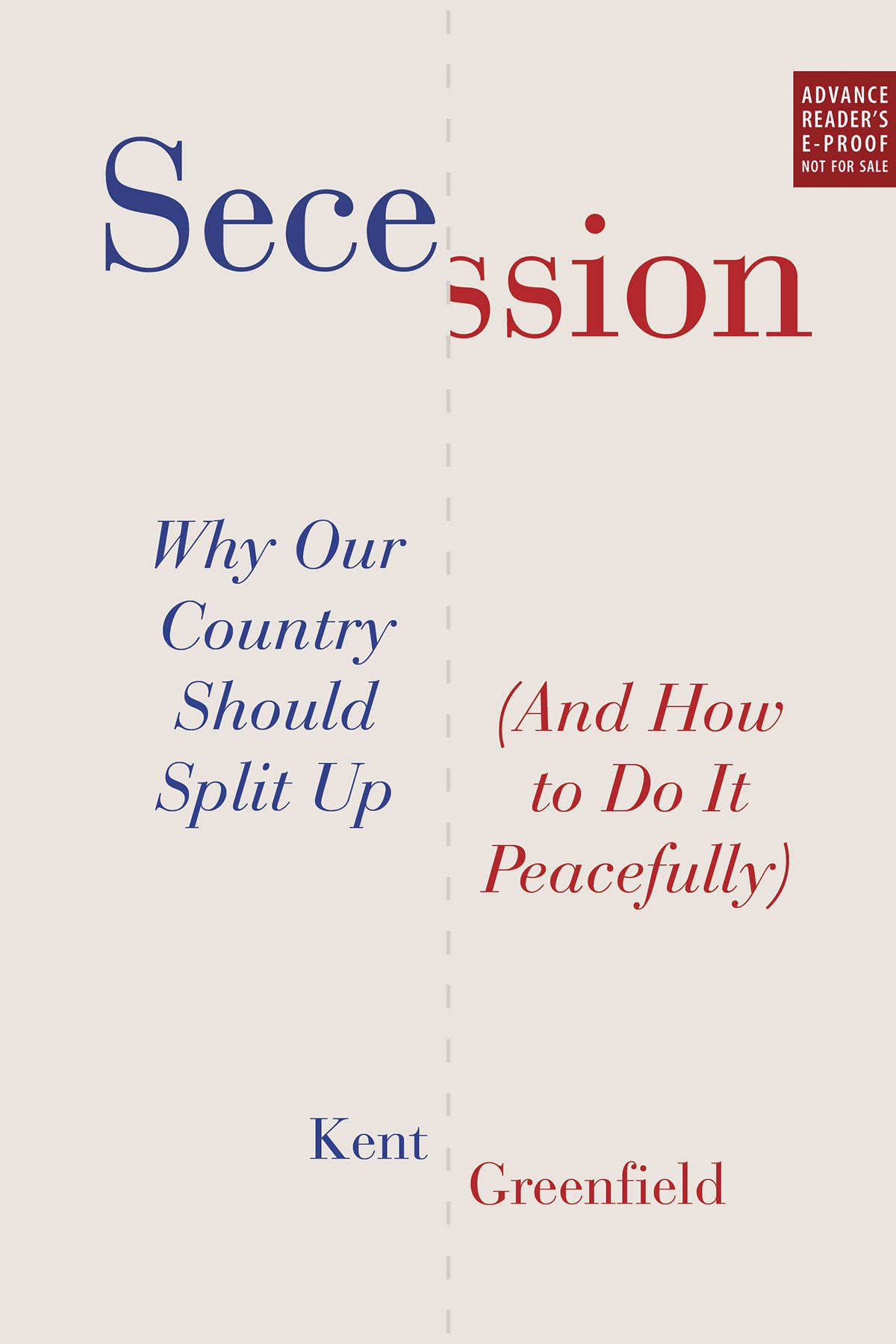
Mr. Book just finished reading Secession: Why Our Country Should Split Up (And How to Do It Peacefully), by Kent Greenfield, published by Mariner Books. The book will be available on January 5, 2027.
Kent Greenfield makes an excellent and persuasive case that the United States might be better off peacefully separating into two countries rather than continuing to struggle to remain one. He recognizes that such a separation would be complicated, but argues convincingly that the difficulties involved should not prevent Americans from seriously considering the possibility.
One of the book’s greatest strengths is Greenfield’s use of a marriage analogy. When two people have grown so far apart that they can no longer live together happily, divorce may be a better alternative than remaining in a miserable marriage. The same principle, he argues, can apply to a country. Americans have become so deeply divided over fundamental issues that continuing to force them to live under the same national government may be doing more harm than good.
An especially effective extension of this analogy concerns the possibility of violence. Greenfield’s argument for secession is based on the premise that it can be accomplished peacefully, through negotiation rather than force. But he also points out that if someone remains in a marriage only because of fear that their spouse will respond violently to an attempt to leave, that is itself a powerful indication that the marriage is unhealthy and separation is necessary. Similarly, the threat of violence should not automatically be considered a sufficient reason for Americans to remain in a political union that is no longer working.
Greenfield also does an excellent job of addressing the inevitable comparison with the Confederacy’s secession before the Civil War. The Southern states sought to preserve slavery, while the peaceful separation he proposes would be motivated by a desire to protect democracy, equality, and individual rights. He makes clear that secession itself should not automatically be condemned because of the circumstances surrounding the Confederacy’s attempt.
Perhaps the book’s most compelling argument comes in its epilogue. Greenfield asks readers to imagine that the United States is already divided into two independent countries, which he calls Bluelandia and Redlandia. He describes their very different political systems, values, and priorities, then asks whether the two countries would benefit from joining together under one government. His argument is that if such a union would make little sense today, Americans should question why preserving an existing union must be considered the better alternative.
Greenfield does not pretend that a peaceful separation would be easy. He examines the obstacles and considers how negotiations might make it possible. But he also makes the important point that maintaining the status quo carries substantial risks of its own.
This is an excellent examination of a proposal that many Americans might initially dismiss as unthinkable. Greenfield makes a compelling argument that it deserves to be taken seriously. Mr. Book found his reasoning persuasive and gives the book an A+.
Mr. Book gives Secession an A+, earning it a place in his Hall of Fame. In Mr. Book’s conversion system, an A equates to 5 stars. (A or A+: 5 stars, B+: 4 stars, B: 3 stars, C: 2 stars, D or F: 1 star).
This review has been published at Goodreads, NetGalley, and Mr. Book’s Book Reviews.
Mr. Book finished reading this book on November 16, 2026.