
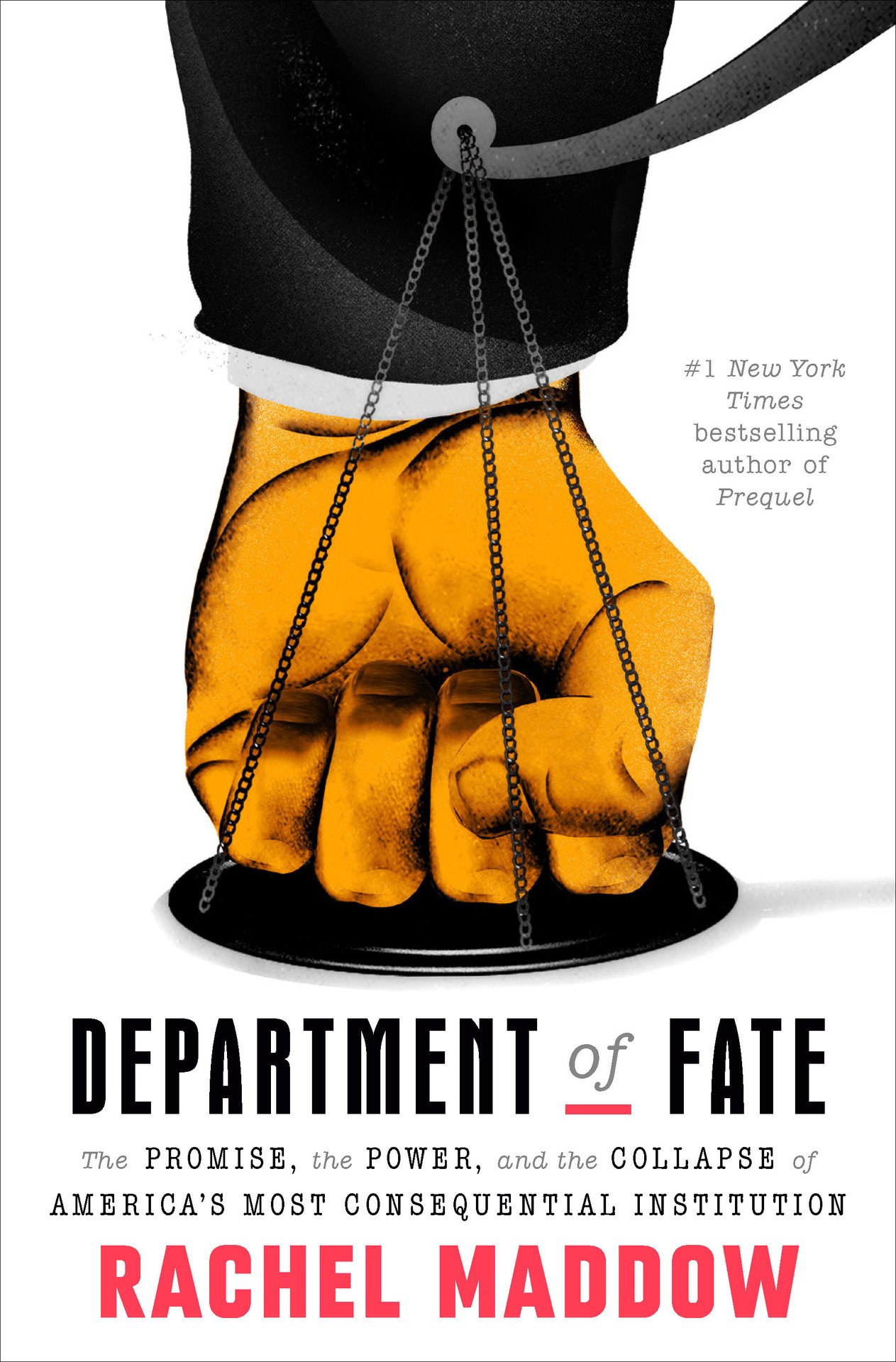
Mr. Book just finished Department of Fate: The Promise, the Power, and the Collapse of America’s Most Consequential Institution, by Rachel Maddow.
In Department of Fate, Maddow examines the history of the United States Department of Justice, an institution with extraordinary power to protect Americans and uphold the rule of law, but also one whose authority has repeatedly been abused for political purposes. Rather than simply presenting a chronological history of the department, she focuses on important episodes that demonstrate what happens when those entrusted with enforcing the law either fulfill their responsibilities or abandon them.
One of the most fascinating stories involves Amos Akerman, who became attorney general under President Ulysses S. Grant just as the Department of Justice was established in 1870. Akerman, a former Confederate who had become a strong supporter of civil rights, led the federal government’s campaign against the Ku Klux Klan during Reconstruction. At a time when white supremacist terrorism was being used to prevent formerly enslaved Americans from exercising their newly established rights, Akerman demonstrated what the Justice Department could accomplish when its leaders were determined to enforce the law.
Maddow provides an excellent account of the violence perpetrated by the Klan, the federal government’s response and the extraordinary obstacles confronting those attempting to bring the perpetrators to justice. Akerman’s determination to protect Black Americans, even in the face of considerable political opposition, makes his story one of the book’s most compelling examples of public service.
Another particularly interesting figure is Louis Post, whose career provides an important connection between two different periods of American history. As a young attorney, Post helped document the federal prosecutions of Klansmen in South Carolina. Nearly fifty years later, as an official in the Department of Labor, he confronted another abuse of federal authority during the Red Scare.
In 1920, Attorney General A. Mitchell Palmer’s campaign against suspected radicals resulted in mass arrests and efforts to deport immigrants, frequently without adequate regard for constitutional protections or the requirements of the law. Post refused to participate in these abuses. He carefully reviewed deportation cases, canceled warrants that lacked a legitimate legal basis and defended his decisions against congressional attacks.
His story is particularly effective because it demonstrates that defending the rule of law does not mean protecting only sympathetic individuals. It means insisting that the government follow the law even when dealing with people whose political beliefs are unpopular.
The book also examines the Teapot Dome scandal and the Justice Department under Attorney General Harry Daugherty during the Harding administration. The corruption surrounding the administration provides another illustration of how political connections and personal interests can compromise an institution supposedly responsible for ensuring that the law is enforced impartially.
Maddow then turns to the Reagan administration and Attorney General Edwin Meese, particularly his handling of the Iran-Contra scandal. The administration’s efforts to circumvent congressional restrictions on assistance to the Nicaraguan contras, combined with its secret arms dealings with Iran, presented serious questions about presidential authority and the obligation to obey laws enacted by Congress.
Meese’s approach reflected an expansive view of presidential power, one in which protecting the president could take precedence over the Justice Department’s responsibility to enforce the law. Maddow also explores the development of legal arguments that would later be used to justify even broader presidential control over the executive branch.
These historical episodes establish the foundation for the book’s examination of William Barr and his service as attorney general under Donald Trump.
Maddow’s account of Barr is particularly devastating. She traces his longstanding beliefs about presidential authority and examines how those beliefs influenced his conduct during the Trump administration.
One of the most important examples involves Barr’s handling of Special Counsel Robert Mueller’s report on Russian interference in the 2016 presidential election. Rather than allowing the public to examine Mueller’s findings before reaching conclusions, Barr issued his own characterization of the report while withholding the report itself and the executive summaries prepared by Mueller’s investigators.
The resulting public impression was substantially different from what the report actually established. Maddow demonstrates how Barr used the credibility and authority of the Justice Department to advance a misleading interpretation favorable to Trump.
The book also examines the targeting of FBI officials who became subjects of Trump’s attacks, including Andrew McCabe, Peter Strzok and Lisa Page. Their experiences illustrate the dangers of turning federal law enforcement into a weapon against individuals perceived as political enemies.
Another important episode concerns Barr’s conduct surrounding the 2020 presidential election. Maddow describes his promotion of unsupported claims about widespread voter fraud and his willingness to depart from established Justice Department procedures in pursuit of allegations that could benefit Trump politically.
These accounts demonstrate the central danger running throughout the book: the enormous powers of the Department of Justice can be used not only to protect Americans from wrongdoing but also to intimidate opponents, protect political allies and undermine democratic institutions.
What makes Department of Fate especially effective is the way Maddow connects these episodes across more than 150 years of American history. The story is not simply one of steady institutional progress followed by a sudden collapse. The department has repeatedly faced challenges involving corruption, political interference, abuses of prosecutorial authority and conflicts between loyalty to the president and loyalty to the Constitution.
At the same time, Maddow makes clear that the institution’s history includes individuals who demonstrated extraordinary courage in resisting those pressures. Akerman and Post are especially important examples of officials who understood that enforcing the law sometimes requires standing against powerful political interests.
Maddow does an excellent job bringing these historical figures and events to life while explaining their significance to the present. Her account demonstrates how decisions made by attorneys general and other federal officials can have consequences extending far beyond individual investigations or prosecutions.
The result is an excellent and important examination of the Department of Justice, its history, its extraordinary power and the consequences when that power is abused.
Mr. Book has now read four books by Rachel Maddow. The first three all earned A grades. With Department of Fate, she has raised the bar even higher. Mr. Book gave her her first career A+. Goodreads requires grades on a 1-5 star system. In Mr. Book’s personal conversion system, an A+ equates to 5 stars. (A or A+: 5 stars, B+: 4 stars, B: 3 stars, C: 2 stars, D or F: 1 star).
This review was published at Goodreads and Mr. Book’s Book Reviews.
Mr. Book finished reading this on November 15, 2026.