
Thank you to the University of Nebraska Press for providing a review copy. All opinions are my own.
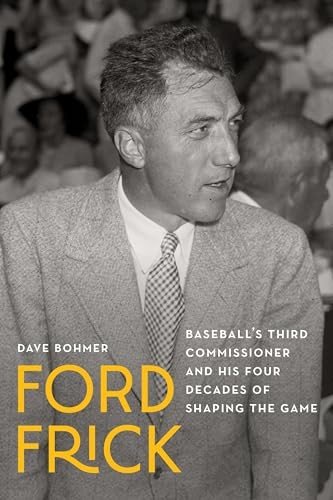
Mr. Book just finished Ford Frick: Baseball’s Third Commissioner and His Four Decades of Shaping the Game, by Dave Bohmer.
This is an excellent biography of one of the most important executives in baseball history. The book covers Frick’s entire career, from his beginnings as a sportswriter to his 17 years as National League president and his subsequent tenure as the third commissioner of Major League Baseball.
One of the book’s central arguments is that Frick has not received sufficient credit for his accomplishments. He has often been portrayed as a weak commissioner who simply did the bidding of the owners. Bohmer challenges that assessment, making the case that Frick was an effective administrator whose leadership helped shape the modern game. And Frick’s career was also overshadowed by the more dominant personality of Judge Landis.
Frick’s baseball career began in journalism. He became a prominent New York sportswriter, covering the Yankees during the Babe Ruth era, and developed a close relationship with Ruth. He also became a successful radio broadcaster before joining the National League’s administration in 1934.
Later that year, Frick became National League president, just as baseball was struggling with the effects of the Great Depression. Several franchises faced serious financial problems, and keeping the league operating was no small accomplishment. Bohmer provides excellent coverage of the financial challenges facing the clubs and Frick’s efforts to keep them in business.
Another highlight is Frick’s role during World War II. Baseball faced uncertainty over whether it could continue operating during the war, and Frick played an active role in dealing with Washington. The book examines the relationship between baseball and the federal government and the challenges of maintaining the sport during wartime. The popular story that FDR sent the ‘green letter’ to Landis shortly after Pearl Harbor, thereby ensuring that baseball would continue operating without further complications, is exposed as a myth. Without Frick’s leadership, there would have been a serious chance of the sport being shut down.
The book also provides extensive coverage of integration and the role Frick played during the period when Jackie Robinson broke baseball’s color barrier.
Franchise relocation and expansion are among the most interesting subjects. During Frick’s years in baseball leadership, the major leagues underwent a geographic transformation. The Braves moved from Boston to Milwaukee, the Browns from St. Louis to Baltimore, the Athletics from Philadelphia to Kansas City, and the Dodgers and Giants from New York to California.
Frick was also involved in the complicated politics surrounding expansion. One particularly interesting example was his opposition to moving the Washington Senators to Minnesota without leaving a major league team in the nation’s capital. Frick recognized that such a move could have serious consequences for baseball’s relationship with Congress, particularly while the sport’s antitrust exemption was under scrutiny.
That leads to another major subject: baseball’s efforts to preserve its antitrust protection. Bohmer provides extensive coverage of the political and legal challenges facing the sport, including congressional investigations and the potential consequences for the reserve clause.
Other important subjects include the difficulties facing the minor leagues, the creation of the amateur draft, changes to baseball’s rules and Frick’s involvement with the Baseball Hall of Fame.
Of course, no examination of Frick’s career would be complete without Roger Maris’s pursuit of Babe Ruth’s single-season home run record in 1961. Frick’s decision to distinguish between records set during 154-game and 162-game seasons became one of the most controversial episodes of his commissionership. Bohmer examines the circumstances surrounding the decision while arguing that it should not overshadow Frick’s much larger contributions to baseball.
One of the strengths of this biography is that it examines the political and administrative challenges facing baseball rather than simply recounting events. Frick had to deal with owners who often had conflicting interests, the separate authority of the two leagues and the changing relationship between baseball and the federal government.
Bohmer makes a strong case that Frick’s ability to negotiate, persuade and work within baseball’s complicated organizational structure was an important part of his effectiveness.
This is an excellent biography that also serves as a history of many of the most consequential developments in Major League Baseball from the 1930s through the 1960s.
Mr. Book gives this book an A. Goodreads requires grades on a 1-5 star system. In my personal conversion system, an A equates to 5 stars. (A or A+: 5 stars, B+: 4 stars, B: 3 stars, C: 2 stars, D or F: 1 star).
This review has been posted at my blog, Mr. Book’s Book Reviews, Goodreads and Mr. Baseball History’s Substack.
Mr. Book originally finished reading this on October 25, 2026.