
Thank you, St. Martin’s Press and NetGalley, for providing this book for review consideration. All opinions are Mr. Book’s own.
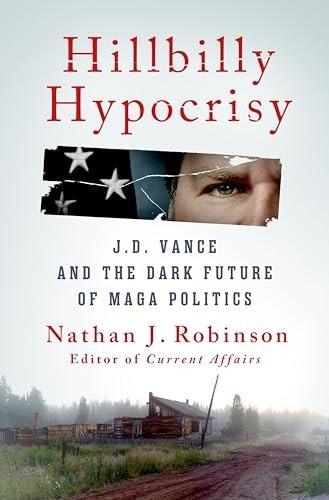
Mr. Book just finished Hillbilly Hypocrisy: JD Vance and the Dark Future of MAGA Politics, by Nathan J. Robinson.
This is an excellent examination of JD Vance, both the hypocrisy surrounding the image he created for himself in Hillbilly Elegy and the danger posed by his political beliefs. Robinson makes a very convincing case that Vance is not simply someone who abandoned his opposition to Donald Trump for political convenience. His record and the ideas he has embraced show that he can be as dangerous as his boss.
One of the major focuses of the book is the mythology surrounding Vance’s background. Hillbilly Elegy made him famous as a spokesman for the struggling white working class, particularly in Appalachia. But Robinson challenges both Vance’s portrayal of his upbringing and the conclusions he drew from it.
Vance’s explanation for poverty places considerable emphasis on cultural problems and personal responsibility. Robinson, however, points to the economic circumstances that shaped the lives of working-class Americans, including the decline of unions and the disappearance of good-paying jobs. One particularly revealing example is Vance’s own family. His grandfather’s union job helped provide the economic stability that allowed the family to enter the middle class. That is a very different story from one that primarily blames struggling people for their own circumstances. Vance’s position is especially one that scapegoats the victims for their own poverty while claiming to be able to relate to a group whose lives he has no way of really understanding.
The book also traces Vance’s transformation from an outspoken Trump critic into one of his most enthusiastic defenders. In 2016, Vance compared Trump’s appeal to a dangerous drug, arguing that he was exploiting the suffering of Americans by offering simplistic solutions that would do nothing to address their problems. He also questioned Trump’s character and fitness for office.
Yet Vance subsequently became a loyal supporter of the same man he had condemned. Robinson examines this transformation alongside Vance’s connections to wealthy Silicon Valley figures and his embrace of increasingly extreme right-wing political ideas.
The discussion of Vance’s political record is especially important. Robinson looks at his brief Senate career, his positions on major issues and his association with intellectual movements that reject important principles of liberal democracy. The book makes clear that Vance’s politics are not simply a more polished version of traditional Republican conservatism.
Robinson also examines Vance’s role in the 2024 election and the Trump administration. The result is a disturbing picture of someone whose political ambitions and ideological commitments could have enormous consequences for the country’s future.
One of the biggest mistakes that Americans could make would be to assume that a Vance presidency would be substantially less dangerous than a Trump presidency. Vance doesn’t have Trump’s cult of personality, but that doesn’t make his positions on the issues any better. A president who pursues the same destructive policies, even without Trump’s personal following, would still be a disaster for the country.
This is the sixth book by Nathan J. Robinson that Mr. Book has read, and the author has put together an outstanding record. Of the previous five, three received an A+ and two received an A. With this book, Robinson improves that record to four A+ grades and two A grades.
Robinson has once again delivered an excellent book, combining a devastating critique of his subject with an examination of the larger political dangers involved. It is an important reminder that the problems with MAGA politics go far beyond Donald Trump himself.
Mr. Book gives this book an A+ and inducts it into his Hall of Fame.
Goodreads and NetGalley require grades on a 1-5 star system. In Mr. Book’s personal conversion system, an A+ equates to 5 stars. (A or A+: 5 stars, B+: 4 stars, B: 3 stars, C: 2 stars, D or F: 1 star).
Mr. Book finished reading this on October 14, 2026. The book will be released to the public on February 9, 2027.
You can also see this review, along with others Mr. Book has written, at his blog, Mr. Book’s Book Reviews.