
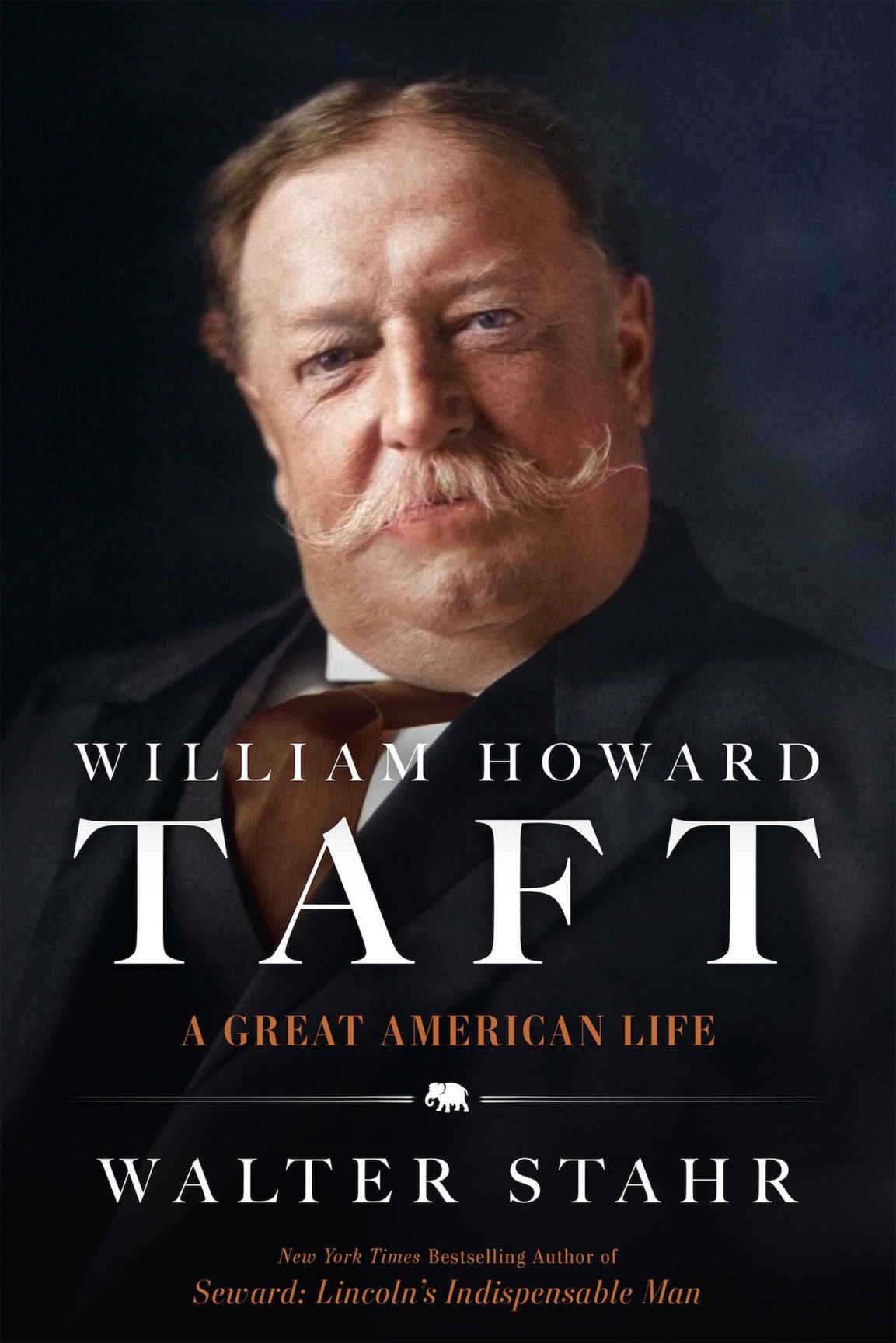
Mr. Book just finished William Howard Taft: A Great American Life, by Walter Stahr.
Mr. Book thanks Simon & Schuster for providing an advance copy through NetGalley in exchange for an honest review. The opinions expressed are Mr. Book’s own.
This book was published by Simon & Schuster on November 10, 2026.
Mr. Book had previously read Walter Stahr’s biography of Salmon P. Chase and awarded it an A, so he entered this book with high expectations. Stahr not only met those expectations but exceeded them with an excellent and exceptionally thorough biography of William Howard Taft.
One of the greatest strengths of this book is its ability to bring Taft to life. Through extensive research, including Taft’s personal correspondence, the biography provides readers with a detailed understanding of Taft’s personality, ambitions, principles, relationships and sense of public duty. While the book reflects considerable admiration for its subject, it never hesitates to point out Taft’s flaws, shortcomings and errors in judgment. The result is a balanced portrait rather than an attempt to glorify its subject.
Although Taft holds the unique distinction of being the only person to serve as both president of the United States and chief justice of the United States, the biography recognizes that there was much more to Taft’s life than his service in those two positions. Considerable attention is devoted to Taft’s family background, early legal career, service as solicitor general and federal judge, years in the Philippines, tenure as secretary of war and activities between his presidency and his appointment as chief justice.
Among the highlights of the book is the coverage of Taft’s years in the Philippines. The book does an excellent job examining the challenges Taft faced in establishing a civilian government and his efforts to increase Filipino participation in that government. Particularly revealing about Taft’s character was his willingness to turn down opportunities to join the Supreme Court, despite his lifelong desire to serve on that Court, because he believed his responsibilities in the Philippines were not yet complete. It was a remarkable example of a public servant placing his responsibilities ahead of his personal ambitions.
Another of the book’s greatest strengths is its examination of the relationship between Taft and Theodore Roosevelt. The evolution of that relationship from a close personal friendship and productive political partnership to a bitter political rivalry is effectively chronicled. The book provides an excellent understanding of how their differences in temperament, political philosophy and views of presidential and judicial power contributed to the deterioration of their relationship, culminating in the Republican split and the presidential election of 1912.
The coverage of Taft’s presidency was one of Mr. Book’s favorite portions of the biography. The book makes a compelling case that Taft’s presidency deserves greater appreciation than it has traditionally received. His administration’s accomplishments were often overshadowed by his political difficulties, his inability to generate the enthusiasm that Roosevelt had inspired and the disastrous conclusion to his presidency. Particularly interesting is the examination of Taft’s more restrained interpretation of presidential power, especially in contrast to the expansive views of Roosevelt. Several of the conventional perceptions of Taft are challenged without overlooking the mistakes that contributed to his political downfall.
Equally impressive is the coverage of Taft’s tenure as chief justice. The book does an excellent job examining not only Taft’s judicial philosophy and the decisions of his Court but also his relationships with his fellow justices and his efforts to improve the functioning of the federal judiciary. Among his most significant accomplishments were the reforms that gave the Supreme Court substantially greater discretion over the cases it would hear, improved the administration of the federal court system and secured congressional authorization for a separate Supreme Court building. The biography makes a persuasive case that Taft’s contributions to the judiciary extended far beyond the opinions he authored and that many aspects of the modern Supreme Court can be traced to his leadership.
The book also effectively challenges the traditional characterization of Taft as a politically inept individual. While there were certainly occasions during his presidency when Taft’s political skills were lacking, his ability to cultivate relationships, build support for his judicial reforms and ultimately secure his appointment as chief justice demonstrated that he was a far more capable political figure than he is generally given credit for being.
Perhaps the greatest accomplishment of this biography is that it succeeds in demonstrating why Taft’s historical significance should not be measured solely by the success or failure of his presidency. His decades of public service, both before and after his years in the White House, provide a much more complete picture of his contributions to American history.
This is an outstanding biography of an underappreciated figure in American history and one that Mr. Book highly recommends to readers interested in presidential history, the history of the Supreme Court or American political history.
Mr. Book has awarded this book an A+ and inducted it into Mr. Book’s Hall of Fame.
Goodreads and NetGalley require grades on a 1–5 star system, and in Mr. Book’s personal conversion system, an A+ equates to 5 stars (A or A+: 5 stars, B+: 4 stars, B: 3 stars, C: 2 stars, D or F: 1 star).
Mr. Book finished reading this book on November 25, 2026.
This review has been published at Mr. Book’s Book Reviews, Goodreads and NetGalley.