
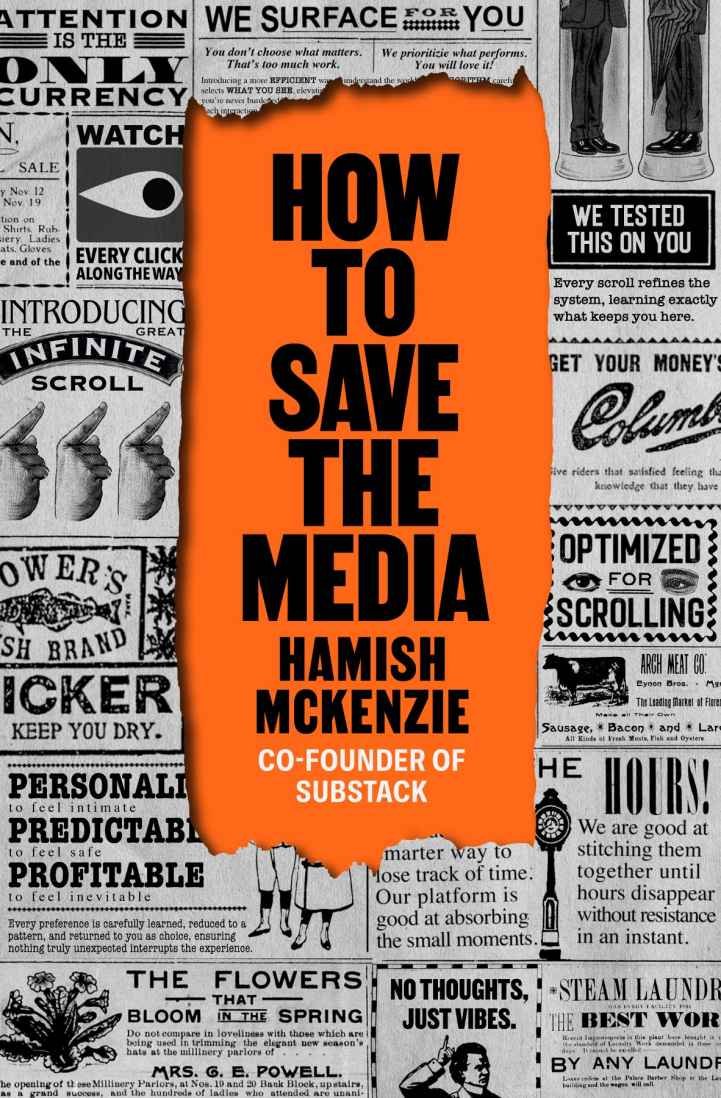
Mr. Book just finished How to Save the Media, by Hamish McKenzie. The book was published on November 17, 2026.
Mr. Book thanks Authors Equity for providing an advance copy through NetGalley in exchange for an honest review. The opinions expressed are Mr. Book’s own.
First of all, readers should ignore the title of this book. Despite being called How to Save the Media, this is not really a book about the media in general. It is primarily a book about Substack, written by Hamish McKenzie, one of the platform’s three co-founders.
McKenzie discusses the creation of Substack, its growth, the challenges it has faced and the philosophy behind its business model. There is also some discussion of other platforms and the problems facing traditional media, but Substack remains the central focus.
The basic concept behind Substack is a good one. It allows writers to publish their work without having to rely on traditional publishers or media organizations. Writers can develop direct relationships with their readers and, if they choose, earn money through paid subscriptions.
Mr. Book is particularly familiar with this concept because he has his own Substack publication devoted to baseball. He appreciates the opportunity the platform provides for anyone who wants to publish their writing, regardless of whether they have an established reputation or a large audience.
Unfortunately, the book spends far too much time concentrating on the prominent writers who have joined Substack and telling their individual stories.
McKenzie clearly considers the success of these writers an important part of the Substack story. However, Mr. Book was far less interested in reading about them. Most of the personalities featured in the book were people whose work he had little interest in following. One notable exception was historian Heather Cox Richardson.
This was the book’s biggest problem. There simply were not enough interesting stories to sustain Mr. Book’s interest.
One of the most interesting sections concerned Substack’s approach to free speech and content moderation, particularly the controversy over the presence of Nazis and other extremists on the platform.
Substack’s leadership faced considerable pressure to remove these publications. Some writers threatened to leave the platform, while others argued that allowing extremist material to remain was inconsistent with the company’s stated values.
McKenzie explains why Substack’s leadership resisted demands for broad censorship. The company believed that allowing people to express unpopular or objectionable opinions was an important part of protecting freedom of expression.
One particularly compelling argument involved the difficulty of defining what should be censored. McKenzie cites former American Civil Liberties Union president Nadine Strossen, who warned that vague definitions of unacceptable speech could easily be manipulated by those in power.
The danger is that rules created to silence objectionable voices today could eventually be used against people advocating for civil rights, political reform or other causes that challenge those in authority.
The book also provides some important context about the actual extent of extremist activity on Substack. McKenzie explains that the publications at the center of the controversy had extremely small audiences. In one example, six publications identified during the controversy had a combined total of just 29 paid subscribers, compared with more than two million paid subscriptions across the platform at the time.
This helped demonstrate that the controversy was much larger than the actual presence and influence of those publications on Substack.
Mr. Book found this discussion particularly worthwhile because it addressed a substantive issue involving the responsibilities of a publishing platform, the limits of free expression and the potential consequences of censorship.
Unfortunately, this was the exception rather than the rule.
There was an interesting book to be written about the creation of Substack, the opportunities it offers independent writers and the philosophical questions surrounding its operation. Some of that material is present here. But too much of the book is devoted to individual success stories that Mr. Book simply did not find compelling.
The result is a book with an interesting premise and some worthwhile discussions, but one that ultimately failed to maintain Mr. Book’s interest.
Mr. Book gives this book a C. Goodreads and NetGalley require grades on a 1–5 star system. In Mr. Book’s conversion system, a C equates to 2 stars. (A or A+: 5 stars, B+: 4 stars, B: 3 stars, C: 2 stars, D or F: 1 star).
This review has been published at NetGalley, Goodreads and Mr. Book’s Book Reviews.
Mr. Book finished reading this book on November 20, 2026.